This website is built and developed by Clickvant

The Five Pillars of Islam
The Five Pillars of Islam are the core acts of worship every Muslim is expected to practise. They are called pillars because Islam rests on them. The Prophet Muhammad (peace be upon him) said that Islam is built on five, a hadith recorded in Sahih al-Bukhari and Sahih Muslim.
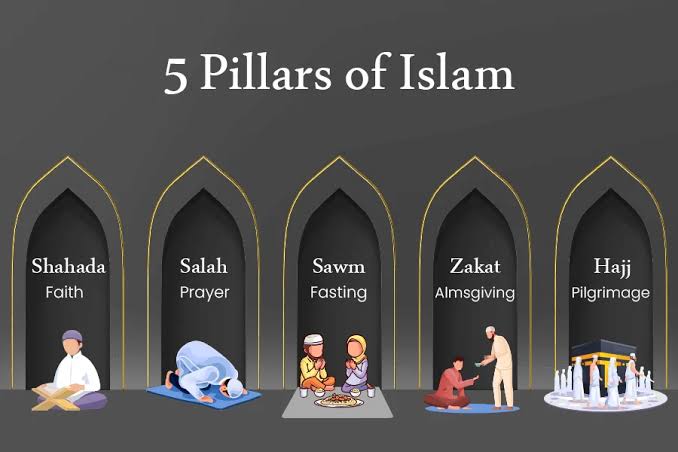
The five pillars at a glance
Pillar 1
Shahada (Faith)
The Shahada is the declaration of faith: that there is no god but Allah, and that Muhammad (peace be upon him) is His Messenger. It is the first pillar and the entry point into Islam.
Saying it sincerely, and believing in it, is what makes a person a Muslim.
Pillar 2
Salah (Prayer)
Muslims pray five times a day: Fajr, Dhuhr, Asr, Maghrib and Isha.
Salah keeps a believer connected to Allah throughout the day and gives daily life a steady rhythm.
Pillar 3
Zakat (Charity)
Zakat is the obligatory giving of a portion of one’s wealth to those in need. The word carries the meaning of purification.
It is paid by Muslims whose wealth is above a minimum threshold known as the nisab, and the usual rate is 2.5% of eligible savings held for a full lunar year. Zakat looks after the poor and keeps wealth from collecting in only a few hands.
Pillar 4
Sawm (Fasting)
Muslims fast during the month of Ramadan, from dawn until sunset. This means no food or drink, and it also means guarding one’s tongue and behaviour.
Fasting builds self-control, gratitude and compassion for those who go without.
Pillar 5
Hajj (Pilgrimage)
Hajj is the pilgrimage to Makkah, performed during the month of Dhul Hijjah. It is required once in a lifetime for every Muslim who is physically and financially able to go.
Pilgrims from every background stand together in the same simple clothing, which is a reminder that all people are equal before Allah.
Why the Five Pillars Matter
Each pillar covers a different part of a believer’s life: belief, worship, generosity, discipline and devotion. A Muslim is expected to hold to all five throughout life, as far as their circumstances allow.